Donor, investor, bank, DFI, foundation, angel, sovereign and institutional contributions enter a programme-aligned architecture.
Programme Fund · Vehicle + Governance + Pricing
Terra Vita Programme Fund — Governance-Aligned Capital Architecture.
A programme-aligned capital vehicle, not a pooled fund. It allows donors, DFIs, banks, VC funds, angels, impact investors, foundations, sovereigns and other capital providers to allocate across governed programme units using readiness, mandate fit and reporting rules.
●The Fund allocates capital; it does not influence evidence.
1. Vehicle Architecture
A fund for ecosystems, not isolated projects.
The Programme Fund reduces capital fragmentation by organising capital around governed programme units and explicit allocation rules.
Capital is routed by readiness, mandate fit, gap status and programme stage.
Allocation follows readiness score, fix-list and cost-of-readiness estimates.
Performance reporting remains tied to governed evidence flows.
Capital providers see the programme architecture rather than disconnected proposals.
2. Capital windows
One vehicle architecture, multiple capital windows.
The Programme Fund architecture can host different capital windows without collapsing them into a pooled fund. Capital remains mandate-specific, instrument-specific and ecosystem-routed.
GR
Grant and donor windows
For early evidence, technical assistance, capacity, baseline and readiness repair.
- Philanthropy
- Foundations
- Donors
- Catalytic grants
CR
Credit and guarantee windows
For bankable programme pathways where evidence, risk and repayment conditions are clear.
- Commercial banks
- Development banks
- Guarantee facilities
- Revolving capital
EQ
Equity and impact windows
For operator, enterprise, platform or ecosystem-company routes where investable exposure exists.
- VC funds
- Angels
- Impact investors
- Strategic capital
LH
Long-horizon institutional windows
For portfolio-level, sovereign, multilateral and institutional routes once evidence becomes repeatable.
- Sovereigns
- Multilaterals
- Institutional investors
- Public facilities
3. Fund Governance
Allocation rules are separate from evidence authority.
The Fund can allocate capital; it cannot influence the evidence layer it relies on.
A
Allocation governance
Capital is routed through readiness, mandate fit, gap status and disbursement conditions.
- Programme-unit eligibility
- Tier route
- Funding gap logic
- Reporting conditions
E
Evidence independence
The Fund cannot alter Hub evidence, suppress gaps or create artificial readiness.
- Read-only evidence reliance
- Reviewer-validated outputs
- Reconstructable audit trail
- Separation of duties
R
Reporting discipline
Capital providers receive governed reporting views tied to the Hub evidence environment.
- Portfolio view
- Gap status
- Verification feed
- Allocation history
4. Governance Pricing
Pricing follows programme responsibility, not arbitrary software usage.
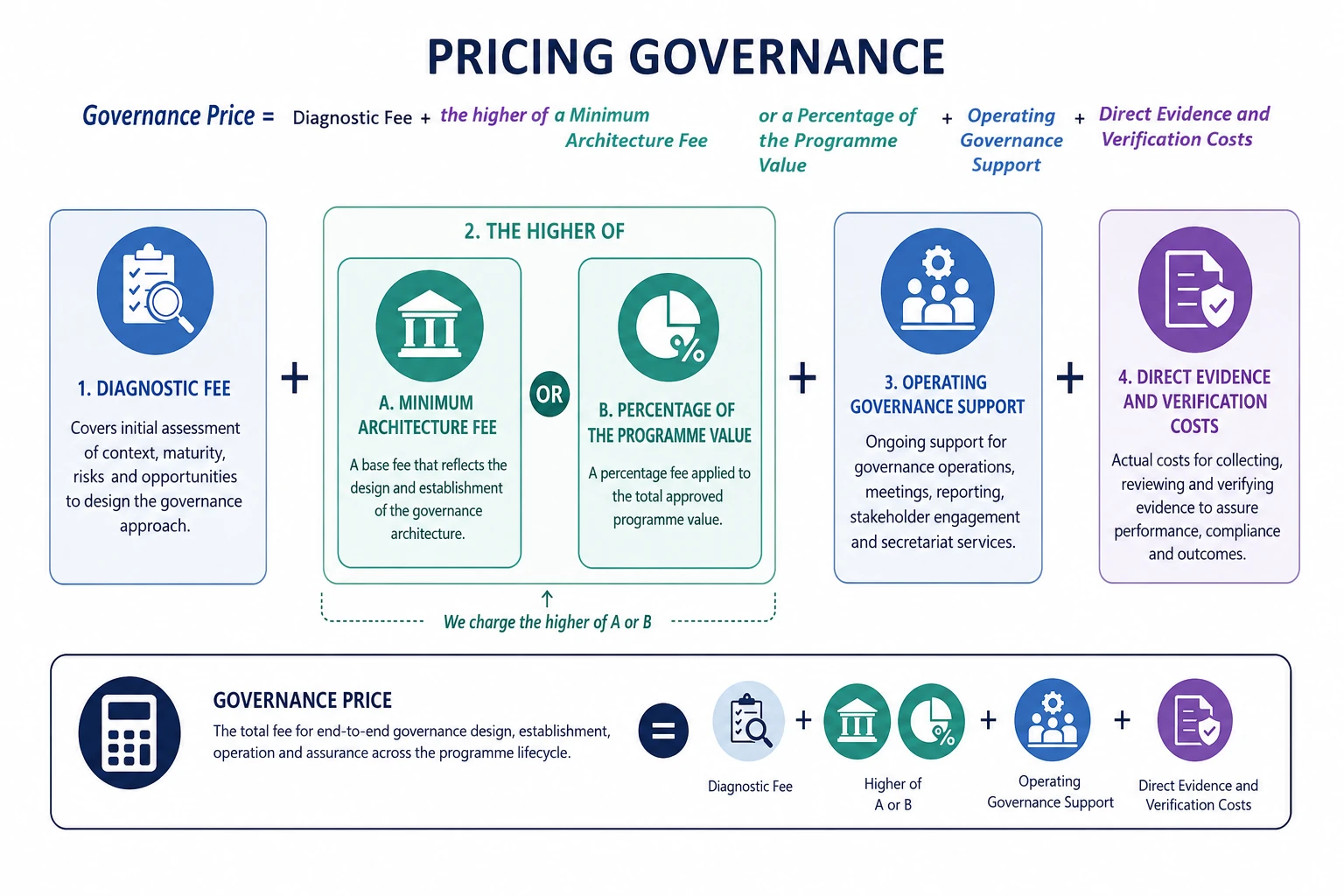
Governance is priced as the work required to design, establish, operate and evidence the programme architecture over its lifecycle, regardless of whether the capital comes from donors, DFIs, banks, investors, angels or blended facilities.
Governance Price =Diagnostic Fee + higher of Minimum Architecture Fee or % of Programme Value + Operating Governance Support + Direct Evidence & Verification Costs
- Diagnostic covers context, maturity, risk and opportunity assessment.
- The higher-of structure protects small programmes and proportional responsibility in larger programmes.
- Operating support covers governance operations, meetings, reporting, stakeholder engagement and secretariat services.
- Direct evidence and verification costs are treated as actual assurance costs.